
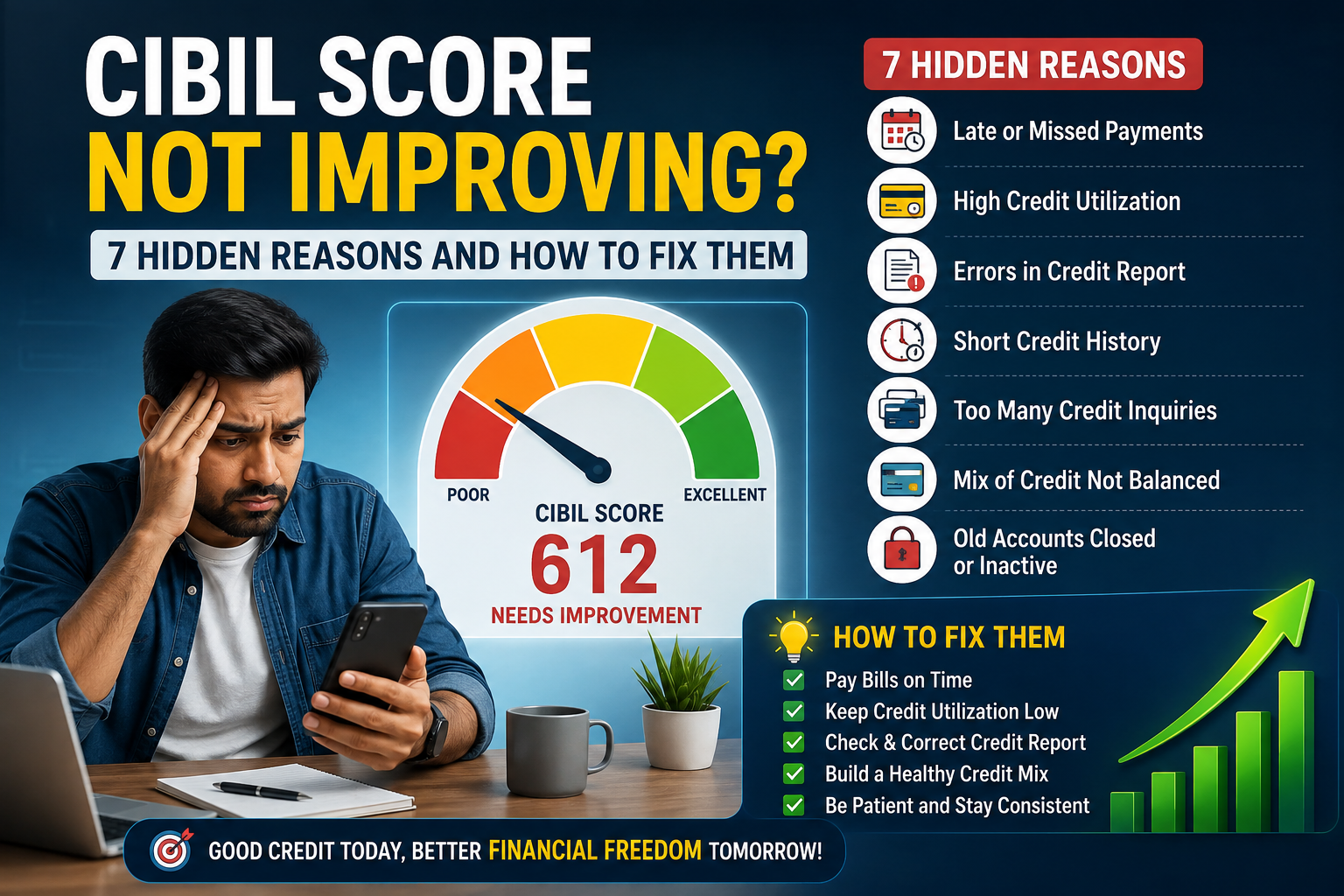
CIBIL Score Not Improving? 7 Hidden Reasons and How to Fix Them
You’re paying your credit card on time. You haven’t missed an EMI in months. And yet, your CIBIL score is stuck — or worse, it’s dropped a few points for no obvious reason. This is one of the most common frustrations people run into, and it usually isn’t bad luck. There’s almost always a specific, fixable cause sitting somewhere in your credit report that isn’t obvious from the outside.
Here are seven of the most overlooked reasons your score isn’t moving, and what to actually do about each one.
1. Your Credit Utilization Is Higher Than You Think
On-time payments matter, but how much of your available credit you’re using matters almost as much. If your card limit is ₹1,00,000 and you’re regularly carrying a balance of ₹40,000 or more — even if you pay it off in full every month — the utilization reported to CIBIL is often based on your statement balance, not your final paid-off amount.
The fix: Try to keep utilization under 30% of your total limit, and ideally under 10% if you’re actively trying to push your score up. Paying down your balance a few days before your statement date (not just before the due date) can make a real difference, since that’s the number that typically gets reported.
2. You Have Too Many Hard Inquiries
Every time you apply for a new credit card or loan, the lender runs a hard inquiry on your credit file. A couple of these won’t hurt much, but applying for multiple cards or loans within a short window signals risk to lenders — it looks like you’re desperate for credit, even if you’re not.
The fix: Space out credit applications by at least 3–6 months where possible. Before applying, check if you’re likely to be approved (many banks offer pre-approval checks that don’t count as hard inquiries) rather than applying broadly and hoping.
3. Your Credit Mix Is Too Narrow
CIBIL rewards borrowers who can responsibly manage different types of credit — a mix of revolving credit (credit cards) and installment credit (personal loans, car loans, home loans). If your entire credit history is just credit cards, or just one personal loan, your score may plateau even with perfect payment behavior.
The fix: This isn’t a reason to take on debt you don’t need, but if you’re already planning a legitimate loan — say, for a two-wheeler or appliance — it can help diversify your credit profile over time. Don’t force this one; let it happen naturally.
4. An Old, Small Debt Is Still Showing as Unpaid
This is one of the most common hidden issues. A closed bank account with a small negative balance, an old credit card with a forgotten annual fee, or a loan you thought was settled years ago can still show up as an active default on your report — sometimes because the lender never updated the status with the bureau.
The fix: Pull your full CIBIL report (not just the score) and go through every listed account line by line. If you find an old account marked as unpaid or defaulted that you believe is settled, raise a dispute directly with CIBIL and follow up with the lender to confirm they’ve reported it correctly.
5. You Closed an Old Credit Card
Closing your oldest credit card feels like a responsible move, especially if you’re not using it. But it can quietly hurt your score in two ways: it shortens your average credit history length, and it reduces your total available credit — which can spike your utilization ratio on the cards you still have.
The fix: If a card has no annual fee, consider keeping it open even with minimal use — a small recurring transaction (like a subscription) that you pay off automatically each month keeps it active without extra effort.
6. You’re an Authorized User or Guarantor on Someone Else’s Debt
If you’ve co-signed a loan, acted as a guarantor, or share a joint account, that debt’s payment behavior affects your score too — even if you’ve never made a payment on it yourself. A missed EMI by the primary borrower can quietly drag your score down without your knowledge.
The fix: Check your credit report for any joint or guaranteed accounts you may have forgotten about. If you’re a guarantor on a loan where payments are inconsistent, that’s worth a direct conversation with the primary borrower — your score is tied to their behavior whether you’re actively involved or not.
7. There’s an Error on Your Credit Report
Bureau errors are more common than most people assume — a payment marked late that wasn’t, an account that isn’t actually yours, an outdated address or employer detail that’s confusing account matching. These errors don’t just look messy; they can actively suppress your score.
The fix: Request your free CIBIL report at least once a year (you’re entitled to one free report annually) and review every entry carefully. If you spot an inaccuracy, file a dispute through CIBIL’s online portal — corrections typically take 30 days and can produce a noticeable score jump if the error was significant.
How Long Does It Take to See Improvement?
Once you’ve addressed one or more of these issues, don’t expect an overnight jump. CIBIL scores typically update on a monthly cycle based on data reported by lenders, so most fixes take one to three reporting cycles to reflect. Utilization changes tend to show up fastest; disputes and report corrections can take a bit longer since they involve verification with the original lender.
The Real Takeaway
A stuck credit score is rarely about bad luck — it’s almost always something specific and traceable sitting in your report. The only way to find it is to actually pull your full report and go through it line by line, rather than just watching the headline number. Most people never do this, which is exactly why these seven issues stay hidden for so long.
This article is for informational purposes only and does not constitute financial advice. Credit scoring criteria and reporting timelines vary by bureau and lender — always verify details directly with CIBIL or your credit provider.


