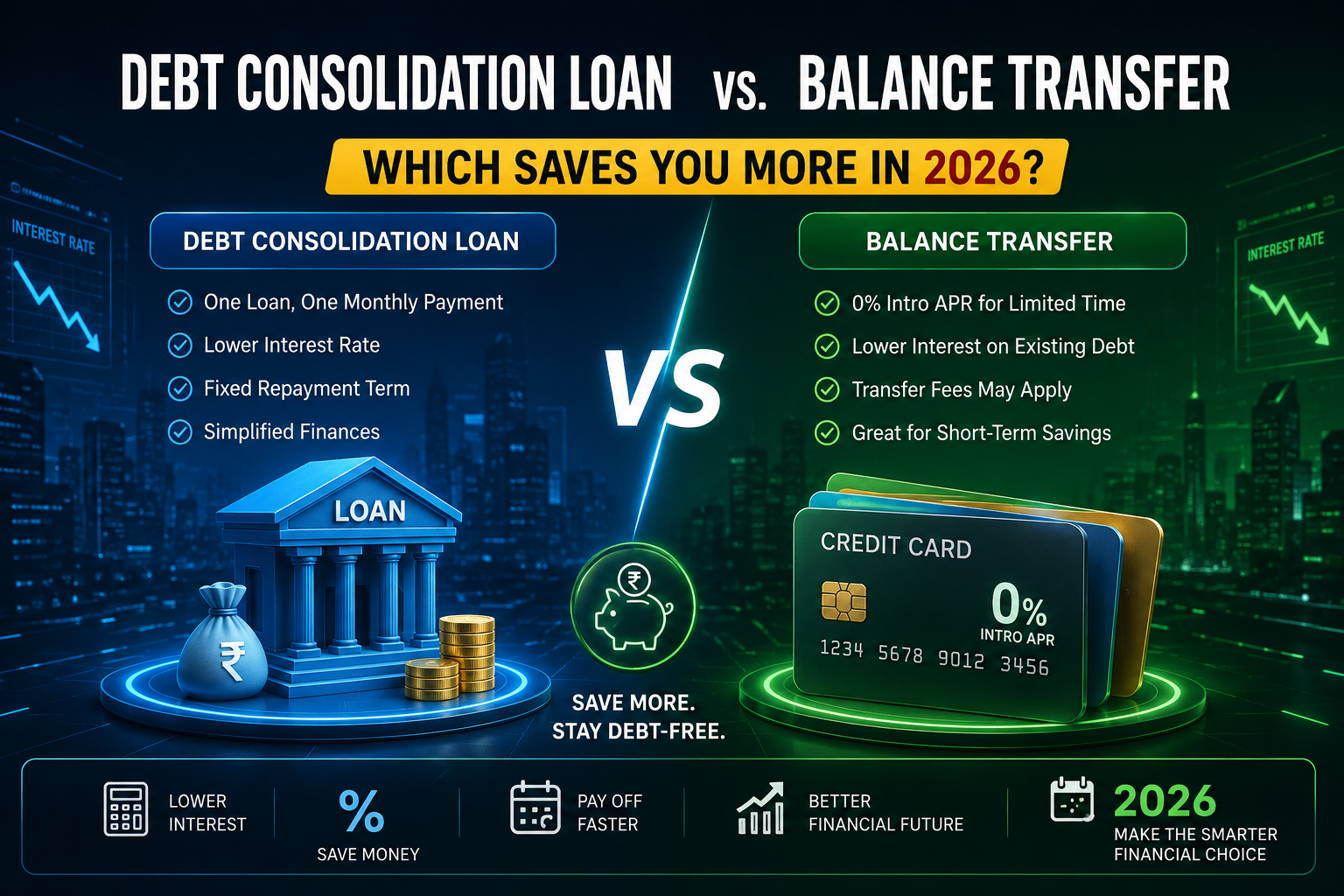
Debt Consolidation Loan vs. Balance Transfer: Which Saves You More in 2026?
I get some version of this question almost every week from clients: “Should I take a consolidation loan, or just move everything to a low-interest card?” And honestly, there’s no universal answer — I’ve seen both go badly when someone picked the wrong one for their situation, and both work beautifully when they fit.
So let’s break down what each option actually does, where the real costs hide, and how to figure out which one fits your numbers.
Debt Consolidation Loans, in Plain Terms
This is a personal loan you take specifically to pay off other debts — cards, older loans, whatever’s outstanding — and roll into one account with a single fixed EMI.
The lender either pays your creditors directly or hands you the money to do it yourself. Either way, you end up with one loan, one due date, and a term that usually runs two to five years.
Rates typically land somewhere between 10.5% and 24% APR depending on your credit profile and lender. That’s often a real improvement over the 30–42% many credit cards charge, which is the whole appeal.
Balance Transfers, in Plain Terms
Here you’re not taking a new loan — you’re moving your existing card balance onto a different card, usually one dangling a 0% or near-0% rate for a limited stretch, often 6 to 18 months.
There’s a catch, obviously. You’ll pay a one-time transfer fee, typically 1–5% of whatever you’re moving. And once that promo window closes, the rate resets — sometimes to something just as painful as what you started with.
What the Numbers Actually Look Like
Say you’re carrying ₹3,00,000 in credit card debt at 36% APR. Here’s roughly how each path compares:
| Factor | Debt Consolidation Loan | Balance Transfer |
|---|---|---|
| Interest rate | ~14% APR, fixed | 0–3% for ~12 months, then 30%+ |
| Fees | 1–2% processing fee | 1–5% transfer fee |
| Term | Fixed, 2–5 years | Must clear before promo ends |
| Monthly payment | Predictable | Can jump sharply later |
| Best fit | Larger, longer-term debt | Smaller debt, fast payoff |
| Credit impact | Adds installment credit, can help credit mix | Adds revolving credit, watch utilization |
If you can genuinely pay off the balance before the promotional period ends, the balance transfer usually wins — you’re paying next to nothing in interest for that stretch. But I’ve watched people underestimate how long payoff actually takes, get hit with the reset rate, and end up worse off than if they’d just taken the loan in the first place. The math only works if your timeline is realistic, not hopeful.
Where a Consolidation Loan Tends to Win
- Your balance is on the larger side — think above ₹2–3 lakh — and would take longer than a year or so to clear
- You’d rather have a payment that doesn’t move than chase a low rate that eventually disappears
- You’re combining more than just card debt — personal loans, other unsecured balances, that kind of mess
- Your credit score actually qualifies you for a rate meaningfully below what you’re currently paying
Where a Balance Transfer Tends to Win
- The debt is manageable enough that you’re confident you can wipe it out inside the intro window
- It’s mostly credit card debt, nothing more complicated
- You trust yourself to stay disciplined — this is the part people underestimate. A 0% rate can feel like breathing room, and breathing room sometimes turns into new spending
- You can actually get approved for a card with a strong intro rate and fees that don’t eat your savings
A Few Mistakes I See Constantly
Be honest about your payoff timeline before you commit to anything. If there’s a real chance you’ll still be carrying a balance when the promo rate expires, run the numbers on what that reset rate would cost you — don’t just assume you’ll be done in time.
Don’t ignore the fee on a balance transfer just because the interest rate looks great. On a large balance, a 5% fee is real money, and it needs to factor into your comparison, not sit as a footnote.
Think twice before closing old accounts the moment they’re paid off. It can affect your credit utilization and the length of your credit history — worth checking with an advisor first rather than closing everything reflexively.
And whichever route you take, the strategy only works if you actually stop adding new charges to the accounts you just cleared. I’ve seen this undo more consolidation plans than bad interest rates ever did.
So Which One Saves You More?
It really comes down to two things: how much debt you’re carrying, and how fast you can honestly repay it.
Smaller debt, quick payoff plan under 12–18 months — balance transfer usually comes out ahead on cost.
Larger debt, longer timeline, or debt spread across different types of credit — a consolidation loan usually wins on predictability and total interest paid.
Before you decide, add up the full cost of each option — interest plus fees, across the time you’d actually need to pay it off — rather than just comparing the interest rates side by side. That one calculation will tell you more than any rule of thumb I could give you here.
This article is for informational purposes only and does not constitute financial advice. Interest rates, fees, and terms vary by lender and are subject to change — always confirm current rates directly with your bank or lender before making a decision.