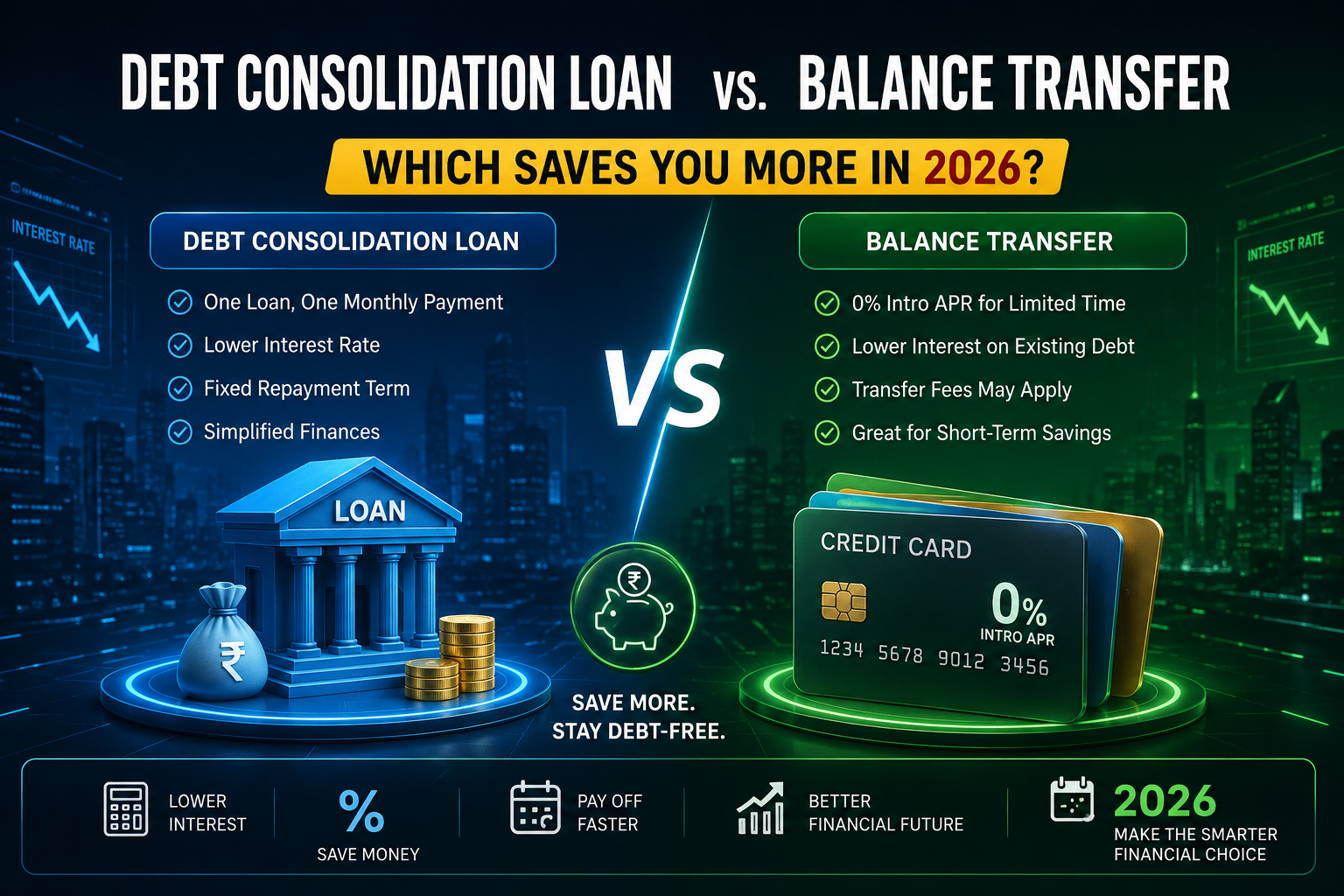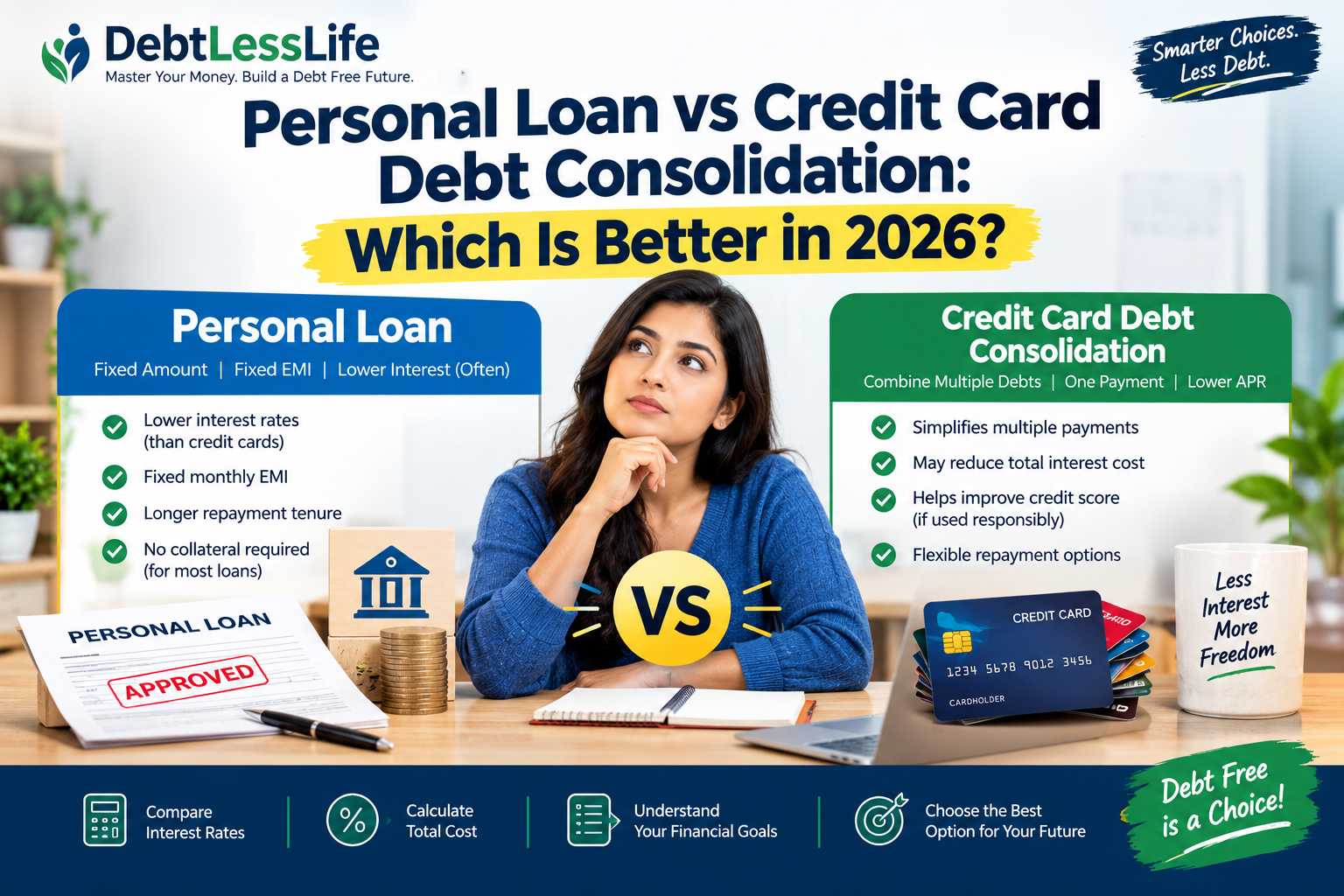
The Rising Credit Card Debt Trap in 2026
Credit cards offer unbeatable convenience, but carrying a balance month-to-month comes at a steep price. In India, most credit cards charge interest rates ranging from 36% to 48% per annum (3% to 4% per month).
If you are paying only the “Minimum Amount Due” each month, it can take anywhere from 5 to 15 years to become completely debt-free, while paying up to three times the original principal in interest alone.
This is where Debt Consolidation comes in. By merging multiple high-interest debts into a single, lower-interest monthly payment, you can save thousands of rupees and clear your liabilities much faster.
What is Debt Consolidation?
Debt consolidation is a financial strategy where you take out a new loan—usually at a lower interest rate—to pay off multiple existing debts. Instead of managing various payment due dates, interest rates, and late fees across multiple cards, you streamline everything into one fixed monthly EMI.
In India, two primary methods are used for consolidating debt:
- Personal Loan for Debt Consolidation
- Credit Card Balance Transfer (CCBT)
Option 1: Personal Loan for Debt Consolidation
Taking an unsecured personal loan from a bank or NBFC to pay off your credit card balance in full is the most common consolidation strategy.
Key Advantages:
- Substantially Lower Interest Rates: Personal loan interest rates typically range between 10.5% and 16% p.a., compared to 40%+ on credit cards.
- Fixed Tenure & Structured EMI: You can choose a repayment tenure from 12 to 60 months, ensuring a clear end date for your debt.
- Boosts Credit Mix: Converting revolving debt (credit cards) into an installment loan (personal loan) positively impacts your credit profile over time.
Drawbacks:
- Processing Fees: Banks charge a processing fee (typically 1% to 3% of the loan amount).
- Strict Eligibility Criteria: Requires a stable income and a decent credit score for approval at competitive interest rates.
Option 2: Credit Card Balance Transfer (CCBT)
A Credit Card Balance Transfer allows you to shift the outstanding balance from a high-interest credit card to another credit card that offers a lower promotional interest rate or a 0% interest period (usually for 3 to 6 months).
Key Advantages:
- Interest-Free Period: Some issuers offer 0% or ultra-low interest for a fixed promotional window.
- Quick Processing: Requires minimal documentation if you already hold an eligible credit card with a sufficient limit.
Drawbacks:
- Short Repayment Window: You must clear the entire transferred amount within 90 to 180 days.
- High Post-Promotional Rates: If you fail to pay off the balance before the promo period ends, regular rates (36%–48%) apply to the remaining balance.
- Processing/Transfer Fees: Issuers charge a balance transfer fee of 1% to 3%.
Comparison Table: Personal Loan vs Credit Card Balance Transfer
| Feature | Personal Loan Consolidation | Credit Card Balance Transfer |
| Typical Interest Rate | 10.5% – 16% p.a. | 0% – 18% (Promotional) / 36%+ (Regular) |
| Repayment Tenure | Flexible (1 to 5 Years) | Short (3 to 6 Months) |
| Best Suited For | Large debt balances requiring 1+ years to clear | Small balances that can be cleared in months |
| Impact on Credit Utilization | Drops revolving utilization immediately | Keeps revolving utilization high |
| Upfront Fees | 1% – 3% Processing Fee | 1% – 3% Transfer Fee |
Real-Life Cost Example: ₹2,00,000 Credit Card Debt
Let’s assume you have an outstanding credit card balance of ₹2,00,000 at 42% p.a. interest, and you decide to consolidate it over a 2-year tenure:
- Continuing on Credit Card (Paying Fixed EMI):
- Interest Paid over 2 Years: ~₹96,000
- Total Payout: ₹2,96,000
- Switching to a Personal Loan at 13% p.a.:
- Interest Paid over 2 Years: ~₹28,300
- Total Payout: ₹2,28,300
- Net Savings: Over ₹67,000 in interest!
You can run your own exact loan tenure numbers using our free Personal Loan EMI Calculator.
How Debt Consolidation Affects Your CIBIL Score
- Short-Term Dip: Applying for a new personal loan results in a hard inquiry on your credit report, causing a minor, temporary dip (5–15 points).
- Drop in Credit Utilization Ratio (CUR): Once the credit card balances are paid off to zero, your credit utilization drops significantly, which gives a major boost to your score.
- Long-Term Improvement: Consistently paying your new loan EMIs on time builds a strong track record of repayment behavior.
If your score is currently below 700, review our step-by-step guide on How to Check and Improve Your CIBIL Score for Free before applying for a consolidation loan.
Which Option Should You Choose?
- Choose a Personal Loan if: Your total credit card debt is high (over ₹1 Lakh), you need more than 6 months to pay it off, and you want fixed, predictable monthly EMIs.
- Choose a Balance Transfer if: Your debt is manageable, and you are 100% confident you can pay off the entire amount within a 3 to 6-month promotional window.
Editorial Disclaimer: Reviewed by Lead Financial Editor Aarav Sharma. Debt Less Life provides financial education and tools. We do not issue loans or extend credit directly. Always read the key fact statement (KFS) and loan agreement terms provided by your lender before proceeding.